Arriving in Kabwe, Zambia
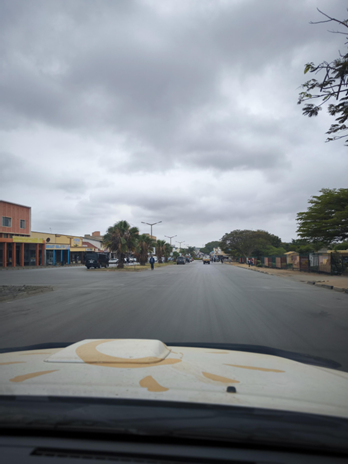
Figure 1: Wentereing Kawbwe’s CBD
We arrived in Kabwe from Lusaka rather late the previous evening. I rose to the sound of my alarm at 5 am the following morning, using the flashlight on my phone to navigate the room’s darkness to prepare for a long day of fieldwork. Our trip to repair household solar products in the Central Province of Zambia was set against the backdrop of the national grid providing a mere three hours of electricity a day– recurring droughts and the nation’s deep reliance on hydroelectric power generation. While our lodge in Kabwe did own diesel generators, their use was restricted to a few hours each evening – understandable given the exorbitant cost of using them for extended periods.
Our team of seven departed for Kapiri Moshi by 5:30, sharing fruit and biscuits as we branched off the main road in Kabwe onto the wide meandering dirt road we’d drive on for several hours that day. We were distributed between two SolarAid vehicles – a 4×4 and a van. Among us were three repair technicians; two from SolarAid and a local repair technician that SolarAid has been training and supporting to repair solar products; a core part of their strategy to decentralise repair services and support 3rd party technicians. We were also accompanied by additional SolarAid staff, a sales administrator and the manager of SolarAid’s repair program. Our main goal for the day was to set up repair stations for small solar products at two rural schools and fix any solar products that community members brought in; apparently, word of our arrival had been communicated to local communities through these schools days prior. Matt Kearnes and I, as part of a team of social researchers who have been collaborating with SolarAid on the subject of off-grid solar repair for several years, were keen to observe and appreciate the ground realities of rural repair in person.
Along the way, streams of students, dressed in white and blue plaid uniforms, walked to school along the same dusty road. We also shared the road with charcoal traders peddling to nearby trading centres; their sacks strung precariously to the back of their bicycles, deftly maintaining balance as they negotiated the road’s many undulations. As in much of Africa, the trade of charcoal in Zambia, which typically flows from low-income rural areas to more affluent urban geographies, is a complex sustainability challenge. It took us about 3 ½ hours to reach our first repair location, Chinshika Primary School. We were greeted by a jovial head teacher who claimed he had a product that needed fixing. We proceeded to set up in between two school blocks – unloading tables, tools, spare parts, a SolarAid banner, boxed Solar Aid products for sale and crucially, a diesel generator to power soldering irons.
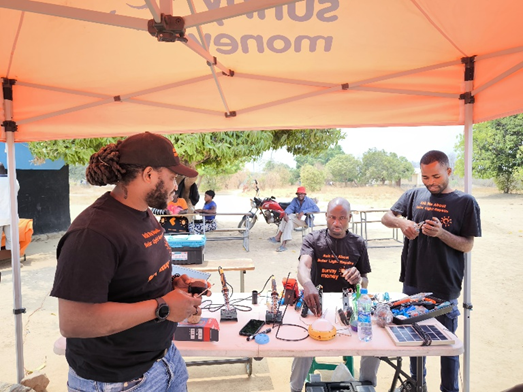
Figure 2: Setting up the repair station
Chinshika Primary School
At the onset, only two community members had products in need of repair. The technicians got straight to work, tending to a few SunKing solar lights brought in for repair while their owners visited the sales table to inspect newer products. The skill and confidence with which they opened and diagnosed issues with these small solar products were impressive, as each technician was familiar with the screws, adhesives, and common problems associated with widely adopted models.
Batteries were easily the most common point of failure. We even received some onsite training on how to use a multimeter to verify this and install a fresh lithium-ion battery if needed. Indeed, these rapid battery replacements represented much of our work as community members trickled in over our three hours at the school. I assisted by sourcing the right battery replacement from a large cardboard box we had brought with us. It contained lithium-ion batteries, coated in blue plastic wrappers, of varied sizes, voltages, and capacities—a testament to the sheer variety of configurations possible and the challenge of sourcing spare parts.
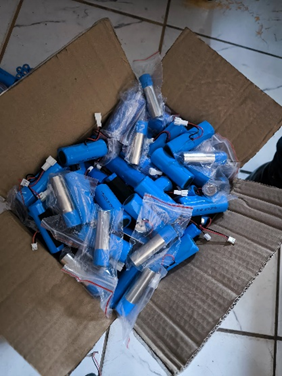
Figure 3: A broad selection of lithium-ion batteries
The SolarAid staff accompanying us spoke of their relief at now being able to source some of these batteries through third parties instead of relying solely on shipments from manufacturers overseas.
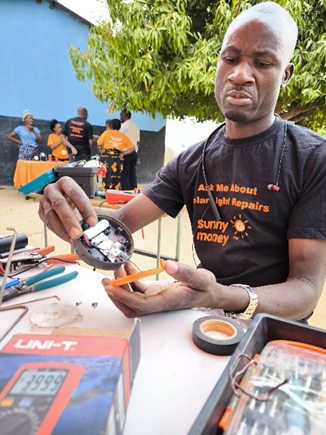
Figure 4: A technician repairs a solar light as customers peruse the sales table (background)
By early afternoon, we had successfully fixed 11 solar lights, all requiring battery replacements that took only a few minutes to complete. The soldering iron was seldom used, except to firm up some connections to the printed circuit boards (PCBs) of a few lights as a precaution. However, there were some exceptions to this smooth process. A popular solar light by d.light, called the A2, is notoriously difficult to open and repair due to the strong adhesive used to seal its body. The technicians recounted how it was “a big day at SolarAid” when they developed a technique to open them safely for repair.
Matt and I watched as one of the technicians delicately twisted open the transparent cover glued to the plastic base that housed the PCB, battery, and LED light. The effort he expended to open an entry-level product was quite remarkable, highlighting how restrictive design practices impede the repair of even the most basic products, often privileging replacement instead.
Another laborious product to fix was a set of solar torches brought in by the head teacher and his colleague. They spoke of their struggles in the dark since the torches had stopped working months ago. A technician speculated that the product was listed on the e-commerce website Alibaba and found in local markets, though they had no prior experience attempting to repair them. One technician spent close to 30 minutes carefully opening each torch and testing components with a multimeter, taking care not to damage the wiring or circuitry. He concluded that some of the batteries were drained and needed replacing. The replacement was ultimately successful, with the head teacher especially pleased with the outcome, despite playfully negotiating a reduction in the repair price before yielding.
All the products repaired at Chinshika Primary were out of warranty. They had been used for years, and in most cases, it wasn’t even clear if they had been originally purchased from SolarAid. All these customers were charged a nominal fee for labour and the cost of the parts replaced, typically totalling between AUD 5-10. This cost would have been waived if the products had been within the 12-month warranty period and had proof of purchase.
“We won’t see you till next year,” the head teacher remarked with a wry smile as we began packing up. He urged the SolarAid team to make more frequent visits to the area to both sell and repair products. Despite having trained a local technician, the team still had to travel 2-3 hours to reach the school using local transportation, an endeavour that didn’t seem economically viable given the relatively small number of repair jobs.
As we were packing up, the diesel generator rented to power the soldering irons stopped working. The technicians’ frustration was evident as they realized the implications of this setback. It meant they would be limited to repair work that did not require soldering irons. This incident vividly illustrated how off-grid solar repair in rural Zambia intersects with the use of fossil fuels and grid-based electricity where and when available.
Curiously though, we observed power lines through much of our journey to our second site, Matt and I were struck by how this grated against the image of the “last mile” that is often invoked in discourses about energy poverty – particularly in the off-grid solar sector. Indeed, as our colleagues elaborated, it was often a case of the last few meters – with households agonisingly close to wires and poles but locked out of grid access due to the high connection costs.
Likumbi Primary School
We arrived at Likumbi Primary School around 1:30 pm and set up under the generous shade of a magnificent mango tree. In the background, schoolchildren enjoyed dusty games of football and netball. A woman eagerly awaited our arrival, holding the battery hub for a Sun King solar home system, easily identifiable by its bright yellow plastic casing.
“My son tried to replace the USB port because it wasn’t working, and now the system won’t turn on,” she explained. The technician promptly opened the case and used his multimeter to diagnose the issue. To her great disappointment, the technician concluded that the PCB had been damaged. Unfortunately, SolarAid had no access to spare PCBs at the time, so replacement was not an option. Additionally, the lack of a soldering iron further restricted our ability to make repairs.
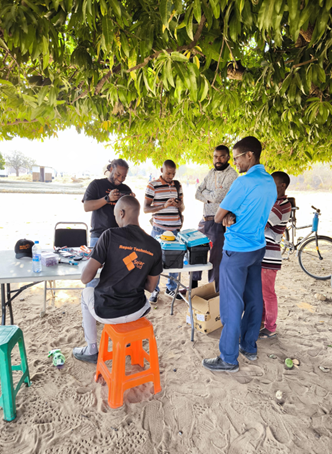
Figure 5: The repair station at Likumbi Primary School, under the shade of a mango tree
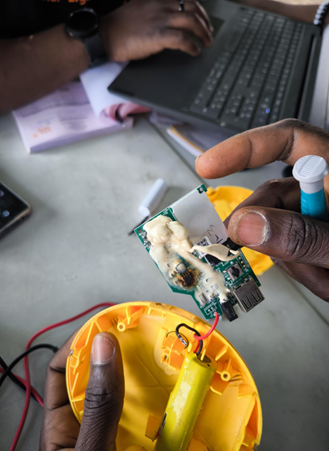
Figure 6: A solar light that the technician claimed has been tampered with
There were several interesting examples of partial repairs. For instance, a Sun King light with PCB issues was partially fixed, allowing the light to function, but not the radio or USB port. Unfortunately, PCB issues are typically not resolved during repair days due to a lack of parts. SolarAid’s technicians described how efforts to work with SunKing to address this had been “challenging”. A shipment of PCBs is expected in November, however reaching customers distributed across remote rural locations like this remains a significant hurdle. Another example of partial repair involved a small light where the original switch was replaced with a non-standard part. The customer had to be advised on how to use the modified system.
There was a lull in activity after the initial repairs. Two SolarAid staff headed to the local trading centre, just a few hundred meters away, to attempt to sell some solar products. They returned about 45 minutes later with a fair bit of success, having sold six products. Some of the technicians took the opportunity to have a short nap. However, the lull gave way to a final wave of activity around 4 pm, the scheduled end of our time at the school. A few customers arrived with lights, and one even brought a home system. One of the customers, according to the technicians, had tampered with the product and thus voided his warranty in the process. As a result, he had to pay for labour and parts – he did so without argument.
One customer rushed back home on his bicycle to get his system and managed to reach us just in time for the final repair of the day. He had worked up a sweat getting to us and anxiously watched as his light was fixed. In line with the pattern of the day, it was a simple battery replacement, and he cracked a smile upon receiving his light back.
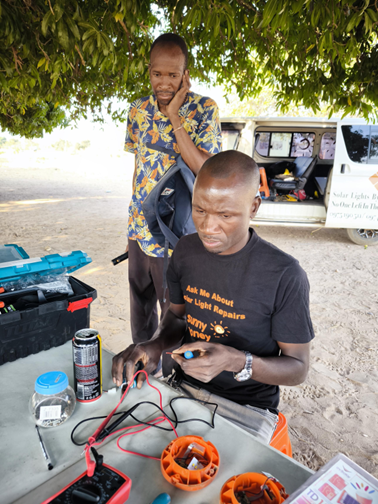
Figure 7: A customer watches anxiously as his solar light is repaired
We packed again and made our way back to Gonde Lodge in Kabwe. The team repaired 18 solar products across the day – a number they considered low compared to previous repair days they had hosted. Nonetheless, there was contentment in the fact that they had managed to successfully extend the productive lives of these products for customers who had poor access to repair services.
Upon our return, the power from the grid had not come back, and the lodge’s generator hadn’t been turned on. Matt and I had some takeaway dinner together, using the light from our mobile phones before heading to bed after a long day. Around 10:30 pm, I heard the beep of the old air conditioning unit in my room – the power was back on.